North-facing rooflights deliver consistent, glare-free daylight year-round. Find out if they suit your project and get a quote from GLRE.


North-facing rooflights work well and are absolutely worth considering, provided you understand what they are designed to do. Rather than delivering the bright, sun-filled light of a south-facing rooflight, a north-facing rooflight provides consistent, diffused daylight throughout the day. This makes them a practical and often ideal choice for specific room types and applications where glare-free, even illumination is more valuable than direct sunlight.
This guide explains how north-facing rooflights perform, which settings suit them best, and what to consider when specifying one for your project.
A north-facing rooflight is any rooflight installed on a roof plane or flat roof where the primary orientation faces north. In the northern hemisphere, including the United Kingdom, north-facing roofs receive no direct sunlight at any time of year. Instead, they receive indirect sky light, which is reflected and diffused rather than beamed in from the sun.
This is distinct from rooflights on south, east, or west-facing roof planes, which will receive varying amounts of direct solar gain depending on the time of day and season. A north-facing rooflight is not a compromise; for many applications, it is the preferred specification.
Yes. The UK’s overcast climate means that diffused sky light is the dominant light source for a significant proportion of the year regardless of orientation. A well-sized north-facing rooflight will deliver meaningful daylighting to a room below throughout daylight hours, without the variation and glare associated with direct sun.
The critical factor is sizing. Because north-facing rooflights do not benefit from solar amplification, you may need a larger or additional unit to achieve the same lux levels in a room compared to a south-facing equivalent. Working with a rooflight specialist during the specification stage will help you arrive at the correct dimensions for your space.
GLRE’s team has decades of experience across architectural glazing projects of all orientations. If you are unsure how to size a rooflight for a north-facing application, get in touch with the GLRE team for guidance before you order.
The most well-known application for north-facing glazing is the artist’s studio. The reason is straightforward: diffused north light does not shift in colour temperature or intensity as the sun moves across the sky. This means the light quality at 9am is comparable to the light quality at 3pm, which is essential when matching colours, working with paint, or evaluating artwork.
The same principle applies to photography studios, architectural model-making spaces, graphic design studios, and any workspace where consistent colour rendering is important. If your rooflight project involves a creative or professional workspace, a north-facing orientation should be your first consideration rather than a fallback.
North-facing rooflights work well in kitchens and open-plan living spaces, particularly where the room already benefits from south or west-facing windows at a lower level. In this scenario, the rooflight supplements the overall light quality with a consistent overhead source, without creating patches of harsh sunlight on worktops or causing glare on screens and reflective surfaces.
In a kitchen extension, a flat glass rooflight or lantern rooflight on a north-facing pitch can deliver even, pleasant working light without the need for blinds or solar control glazing that would otherwise add cost and complexity.
Conservation areas and listed buildings often impose restrictions on solar control coatings, tinted glazing, and certain frame materials. A north-facing rooflight sidesteps some of these challenges because the lack of direct solar gain removes the need for many solar management features in the first place.
For heritage or conservation contexts, a glazing specialist can advise on appropriate specifications. GLRE’s bespoke rooflight service is able to produce units to match specific conservation requirements, including frame profiles and glazing specifications suited to sensitive settings.
In a rear single-storey extension on a north-facing plot, a rooflight is often the most effective way to introduce meaningful daylight to the interior, since the rear wall may face north and side windows may be restricted by boundaries or neighbouring properties.
In this scenario, a mono-pitched flat glass rooflight provides broad, even illumination from above without the glare issues that a south or west-facing unit might present. See our guide on choosing the right rooflight for your UK home for a broader overview of how orientation affects specification.
North-facing rooflights offer several advantages that are often overlooked in favour of solar-maximising south-facing units:
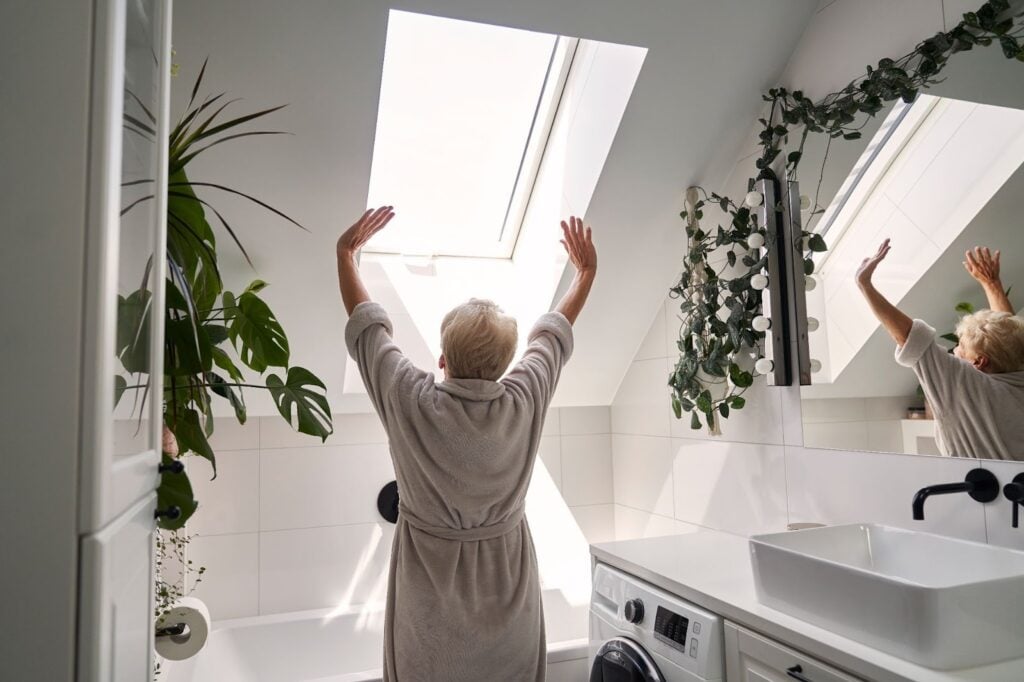
Understanding the limitations is just as important as understanding the benefits. North-facing rooflights are not the right specification in every situation:
The right orientation depends entirely on the intended use of the space and the overall daylighting strategy for the building. The table below summarises the key differences:
| Factor | North-Facing | South-Facing |
| Light consistency | High — even throughout the day | Variable — shifts with sun angle |
| Solar gain | Minimal | Significant, especially in summer |
| Glare risk | Low | High in sunny conditions |
| Best suited for | Studios, kitchens, workspaces | Living rooms, bathrooms, extensions |
| Solar control glass needed? | Rarely | Often recommended |
Any flat roof rooflight can be installed in a north-facing position. The choice of product type should be driven by the room’s functional requirements rather than orientation alone.
A mono-pitched flat glass rooflight is the most commonly specified product for flat roof extensions and is well-suited to north-facing orientations. The low-profile design maximises the glazed area relative to the frame, which is particularly beneficial when working with diffused rather than direct light.
GLRE’s mono-pitched rooflights are pre-assembled and arrive as a single unit, making installation straightforward for your contractor. They are available in a wide range of sizes, with bespoke options available through the GLRE bespoke service for non-standard openings.
Where thermal efficiency is a priority, a triple glazed rooflight is worth considering for north-facing positions. Because there is no solar gain to offset heat loss through the glazing, a higher-performance unit will reduce the thermal impact of the rooflight on your heating costs, particularly in winter.
Our guide on triple glazing rooflights and condensation prevention covers the thermal and condensation benefits of upgrading from double to triple glazed units in detail.
A pyramid rooflight or lantern rooflight can work well on a north-facing flat roof where additional ceiling height is desired alongside diffused daylighting. The angled panes catch light from multiple points in the sky simultaneously, which can improve overall light transmission compared to a flat unit of the same footprint.
In most cases, no. Standard double glazed units with a low-emissivity coating are appropriate for north-facing rooflights in UK residential and commercial buildings. The absence of direct solar exposure means that solar control glass, which is designed to reduce heat gain from direct sun, is generally unnecessary and would simply reduce the already-limited light transmission.
If the rooflight is in a conservation area or heritage setting, or if there are specific planning conditions relating to glass specification, GLRE can advise on appropriate options. GOV.UK provides guidance on planning rules for listed buildings and conservation areas if you are unsure whether restrictions apply to your property.
For north-facing positions in rooms that are prone to condensation or heat loss, upgrading to a triple glazed unit is a sensible investment. See our overview of double glazed versus triple glazed rooflights for a breakdown of the specification differences.
A north-facing rooflight is likely to be the right specification if:
A north-facing rooflight is less likely to be the right specification if the primary goal is maximum solar warmth, seasonal sunlight, or a dramatic sun-filled effect in a living or recreational space. In those cases, review the full GLRE rooflight range and consider your orientation options carefully.
Not sure which rooflight orientation or product suits your project? Contact the GLRE team today and we will help you specify the right solution from the outset.